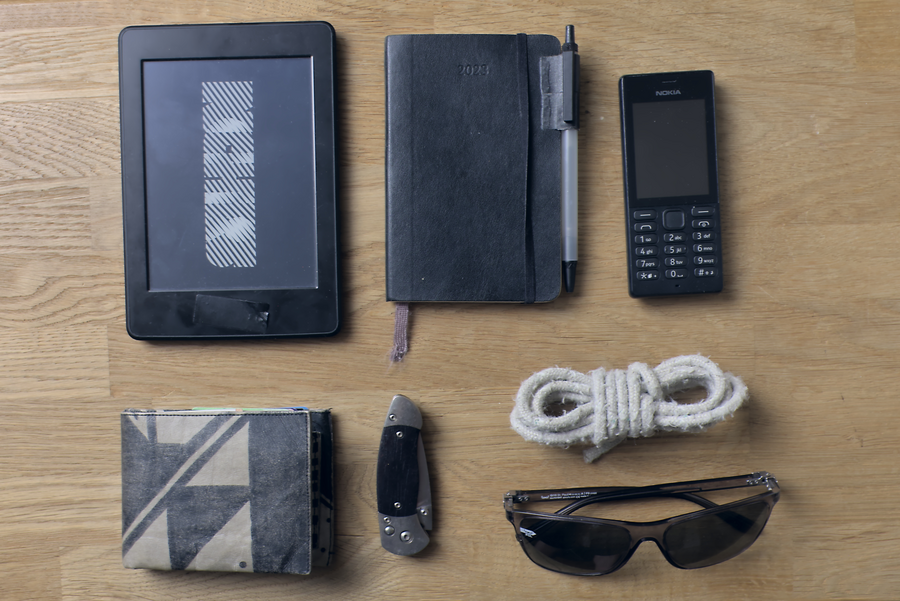
Recurring items.
"Perfection is achieved, not when there is nothing more to add, but when there is nothing left to take away."
— Antoine de Saint-Exupéry, Airman's Odyssey
Aquisition
Consumer society and it's norms makes it extremely easy to aquire things. If you have awareness about the resources that need to be extracted to produce these things, the values and intentions they were designed and produced with and have an idea about the environmental impact of their life-cycle it becomes increasingly difficult to get rid of them again; particularly when the are charged with sentimental value. Instead of burdening myself with these implications, I try to select tools few and carefully based on values and beliefs: repair, reuse, recycle - see grinder, player, workstation or handdrill.
Others often label me a minimalist, but when I look at the wealth of objects in my possesion, I cannot help but wonder if we have a different understanding of the term.
- I am easily overwhelmed and many items cause stimulation and noise
- I do not wish
Guidelines for aquiring new items
Before you aquire any new item ask yourself the following questions:
- Do I really need it?
- What exact purpose will it serve?
- Is there an alternative I already own?
- How much better will it make whatever I intend to do with it in comparison to the alternative I already own?
- Can I make it myself?
- Is it reperable? Can I repair it myself when it breaks?
- Can I buy it pre-owned?
- What are the environmental implications (production, transport, usage, end-of-lifecycle)?
- What are the social implications (working conditions, political conditions, manufacturer ethics)?
General rules of thumb
- Most items have already been produced. Try to aquire pre-owned items as much as possible.
- Try to avoid items that you wouldn't burn in your own stove.
- Don't fill your inventory with items for ocasions that happen once per year. Plan for the other 255 days.
Tools
Everyday
Household
Instruments
Games